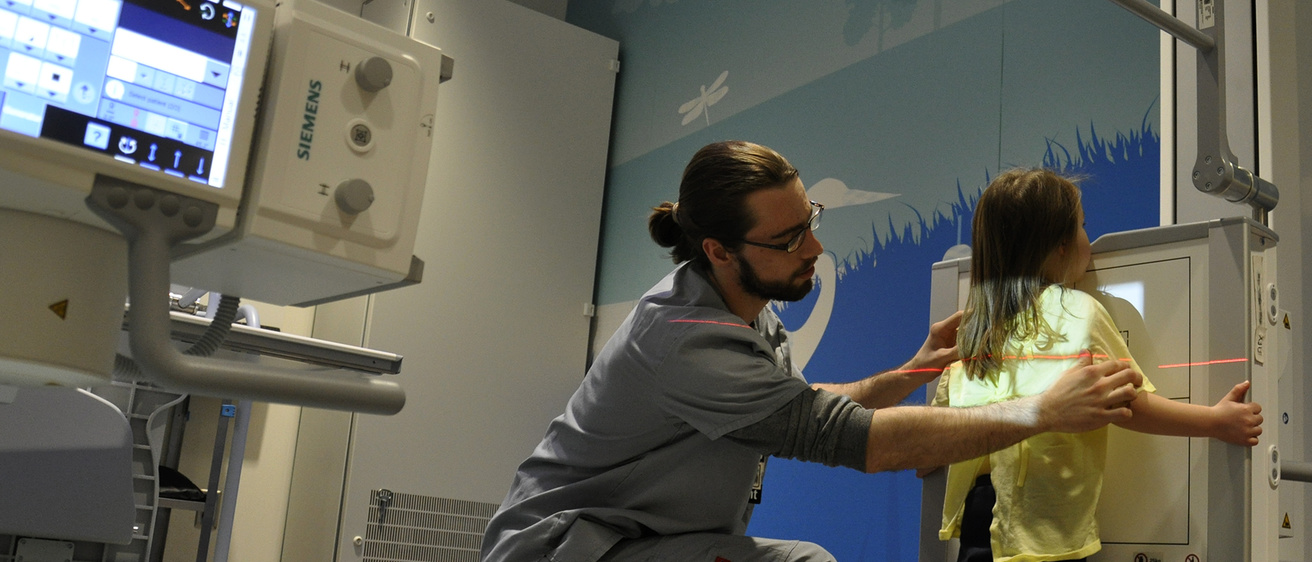
Radiation sciences professionals work with a team of health professionals to gather accurate patient information for diagnosis and treatment of disease and injury.
Technologists operate x-ray, CT (computed tomography), MRI (magnetic resonance imaging), radiation therapy, ultrasound, and similar equipment essential in a hospital or health care setting.
Technologists must possess knowledge, skill, and mature judgment to operate complex equipment safely and efficiently. They produce quality images using multiple sources of radiation and they deliver quality patient care during diagnosis and treatment procedures.
Pursuing this degree as an undergraduate at Iowa allows you to complete the mandatory competencies and courses that allow you to apply to take the national board exams required to practice professionally.
Iowa's Radiation Sciences program has an excellent reputation and student pass rate for certification exams. It offers seven areas of specialization within the field.
The program is sponsored by the University of Iowa in cooperation with the university's Carver College of Medicine and the Department of Radiology. It is affiliated with University of Iowa Hospitals and Clinics (UIHC), one of the nation’s largest public university teaching hospitals.
These connections and the program’s location on the University of Iowa health sciences campus provide a wealth of world-class resources and learning opportunities for students.
Radiation sciences is one of two undergraduate majors in the field of medical imaging offered by the Carver College of Medicine.
Admission to the radiation sciences major is competitive and selective, and meeting the requirements for admission does not guarantee acceptance into a professional program or the major.
Acceptance into the Carver College of Medicine Radiation Sciences major requires an application, an essay, and an interview. Previous hands-on patient care and job-shadowing experience are highly recommended.
Students who wish to enter the Radiation Sciences Program must first be admitted to the University of Iowa as College of Liberal Arts and Sciences (CLAS) students with a Radiation Sciences Interest and complete the prerequisite course work.
CLAS students must apply to the radiation sciences professional program of their choice by January 15 of the year in which they wish to enter. See Apply on the Radiation Sciences Program website.
Transfer students are encouraged to apply in early December to allow for time for transfer course articulation. Accepted students enter a professional program, the radiation sciences major, and the Carver College of Medicine the following fall semester.
Information



Radiation Sciences graduates have a 100 percent job placement rate and the University of Iowa's Pomerantz Career Center offers multiple resources to help students find jobs.
Graduates generally find jobs in hospitals, clinics, imaging centers, and physicians’ offices. Most radiation sciences professionals with full-time jobs work 40 hours a week and may have holiday, weekend, evening, night, and on-call hours. With experience, and sometimes additional education, graduates may find related jobs in management, sales, or education.
Students who complete Iowa's professional radiation sciences programs are eligible to apply to take national certification exams administered by the appropriate national agency in order to practice.
Licensure laws vary from state to state. Iowa is a licensing state, requiring radiographers to have a permit to practice. Passing the national exam is a criterion used to issue a permit to practice.
In addition to more than 500 Student Organizations, Iowa students choose from more than 100 Study Abroad Programs and multiple Undergraduate Research Opportunities.
Students in this major are encouraged to join the Radiation Sciences Student Organization and participate in numerous networking opportunities with both students and radiation sciences alumni.
The University of Iowa provides a variety of scholarships to eligible undergraduate students through the Iowa Scholarship Portal. Scholarships are available to first-year, transfer, and currently enrolled students. For additional details on scholarships for your program of study, check directly with the department or college.
The Department of Radiology awards the Scot Heery Scholarship to three seniors each year in recognition of their work ethic and daily commitment to quality patient care.
The Office of Admissions and the Office of Student Financial Aid are great resources for students seeking scholarships.
There are two components to the Bachelor of Science (BS) degree in radiation sciences: prerequisite course work and courses for one of the professional programs or tracks.
Prerequisite course work includes completing GE CLAS Core requirements and required course work for radiation sciences, as outlined in the UI General Catalog.
Eligible students apply to the following three-year tracks:
- Diagnostic Medical Sonography (DMS) and General and Vascular
- Diagnostic Medical Sonography (DMS) and Cardiac and Vascular
- Radiologic Technology (RT) and Breast Imaging (BI)
- Radiologic Technology (RT) and Cardiovascular Interventional (CVI)
- Radiologic Technology (RT) and Computed Tomography (CT)
- Radiologic Technology (RT) and Magnetic Resonance Imaging (MRI)
Students are advised for success, based on academic strength, not necessarily for a four-year plan. Prerequisites for these programs may take more than one year to complete.
Eligible students may apply to the following two-year tracks:
- Radiologic Technology
- Radiation Therapy (RTT)
See Radiation Sciences in the UI General Catalog for additional information.