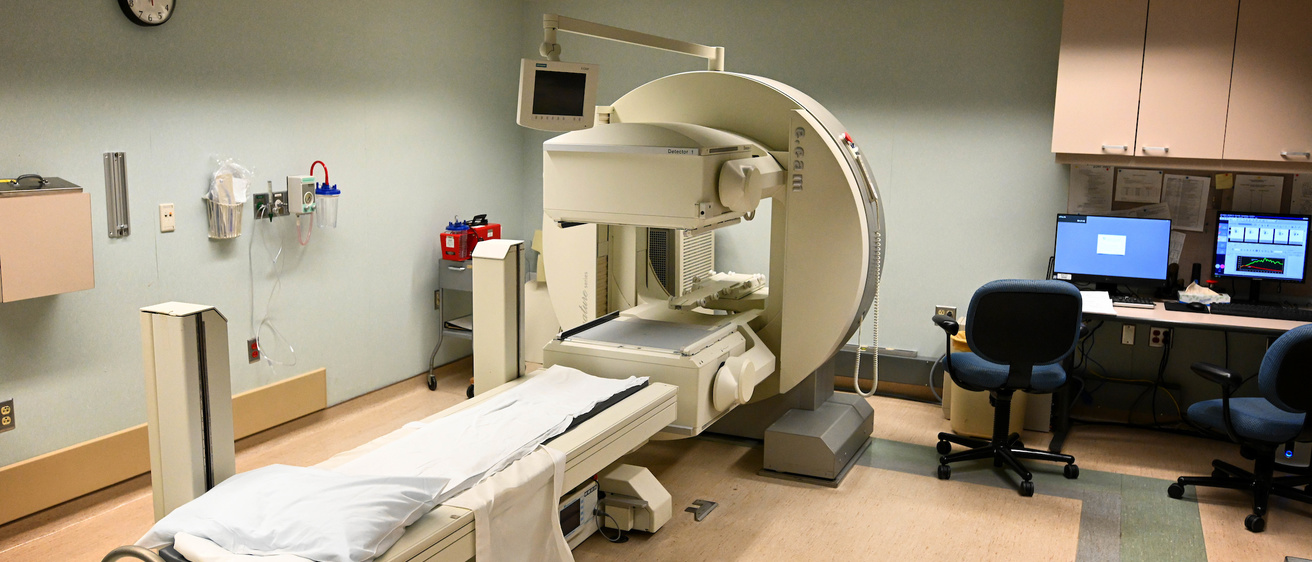
A nuclear medicine technologist is a healthcare professional who specializes in the preparation and administration of radioactive materials for diagnostic imaging and therapeutic procedures. Working as part of a multidisciplinary medical team, they collaborate closely with nuclear medicine physicians, radiologists, medical physicists, and other healthcare providers.
Nuclear medicine technologists play a vital role in diagnosing and treating a wide range of conditions, including cancer, heart disease, and neurological disorders. Their primary responsibilities include imaging procedures, radiopharmaceutical preparation and administration, patient care, equipment operation and quality control, and data analysis and documentation.
Why Iowa?
Iowa’s renowned health sciences campus offers invaluable learning opportunities for students in the Nuclear Medicine Technology (NMT) Program. Iowa’s program is fully accredited by the Joint Review Committee on Educational Programs in nuclear medicine technology.
You'll have access to the world-class teachers, researchers, and facilities of the university's Carver College of Medicine and University of Iowa Health Care, one of the nation’s largest academic medical centers.
Iowa also offers related undergraduate degree programs in radiation sciences.
Admission Requirements
Students interested in this major need to meet the requirements for admission to the College of Liberal Arts and Sciences.
Admission to the nuclear medicine technology BS degree program is selective and competitive. The program admits a maximum of eight students per year.
Students planning to apply to the NMT program should meet with their advisor in the Academic Advising Center. They must complete the following:
- At least 60 hours of college course work with a cumulative GPA of at least 2.50
- Rhetoric
- Science courses in chemistry (including laboratory), physics, anatomy (including laboratory) and physiology (including laboratory). Courses in biology, statistics, and computer science are also recommended.
- Elementary functions or precalculus
- Medical terminology
- Elementary psychology
- Courses in culture, society and the arts
Review the Nuclear Medicine Technology Program website for more details about admission requirements and how to apply. Completing the minimum requirements does not guarantee acceptance to the program.
Information

First-Year

Transfer

International
Careers and Outcomes
Our Pomerantz Career Center offers multiple resources to help students find internships and jobs.
Iowa’s nuclear medicine technology program has an outstanding record of job placement. Over the past five years, within six months of graduating, 100 percent of NMT graduates have been employed or continued their education.
Graduates typically begin working as work as nuclear medicine technologists, beginning as entry-level staff technologists at hospitals or clinics.
With experience and advanced degrees, NMT graduates also find career opportunities in education as instructors, coordinators, or program directors; and in administration, industry, or research and development. Those pursuing government-related jobs might find positions as regulatory agency inspectors or radiation safety officers.
Student Opportunities
In addition to more than 600 Student Organizations, Iowa students choose from more than 100 Study Abroad Programs, and multiple Undergraduate Research Opportunities.
Students in this major are encouraged to join the Radiation Sciences Student Organization and participate in numerous networking opportunities with both students and radiation sciences alumni.
Scholarships
The University of Iowa provides a variety of scholarships to eligible undergraduate students through the Iowa Scholarship Portal. Scholarships are available to first-year, transfer, and currently enrolled students. For additional details on scholarships for your program of study, check directly with the department or college.
The Office of Admissions and the Office of Student Financial Aid are great resources for students seeking scholarships.
Coursework
Students accepted to the Nuclear Medicine Technology Program complete two years of didactic coursework and clinical experience in the Carver College of Medicine Students participate in hands-on clinical rotations at the University of Iowa Health Care locations as well as other nearby institutions.
Upon completion of the requirements of the NMT curriculum, students earn a Bachelor of Science degree from the UI Carver College of Medicine. Graduates are eligible to apply for national certification exams in nuclear medicine technology.
See nuclear medicine technology in the UI General Catalog to learn more about this degree program.